
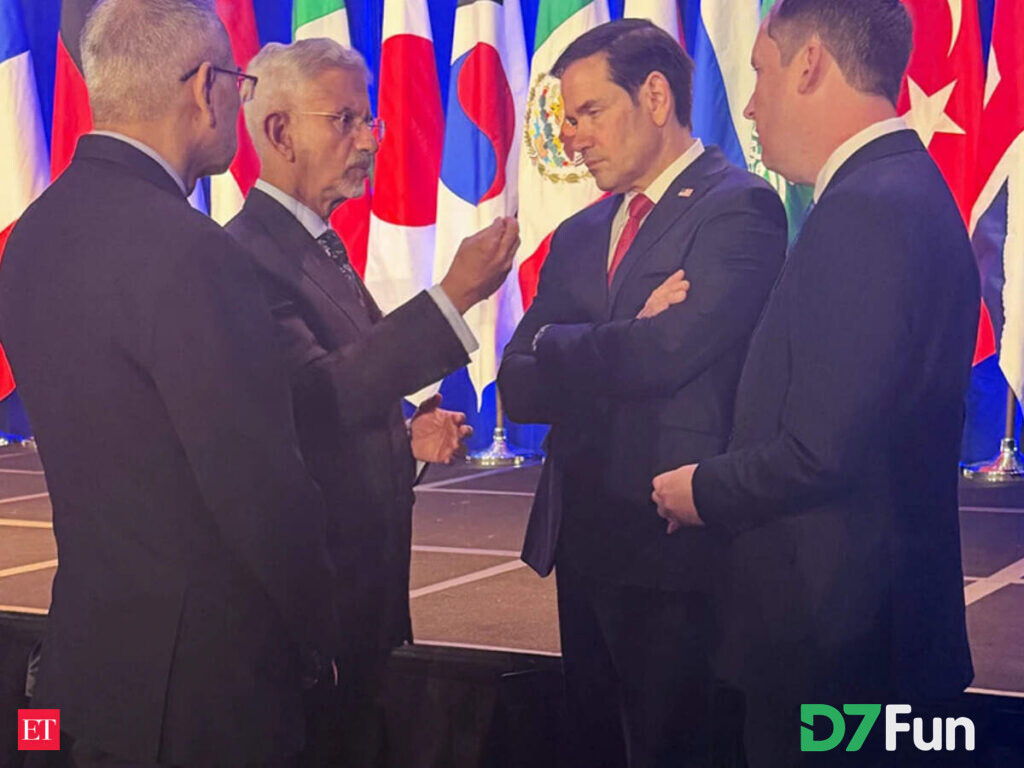
Jaishankar-Rubio Meeting Puts India-US Partnership in the Spotlight
External Affairs Minister S Jaishankar held an important bilateral meeting with US Secretary of State Marco Rubio in Atlanta on the sidelines of the G20 Foreign Ministers’ Meeting. The discussion came at a time when global diplomacy is dealing with several overlapping challenges, from geopolitical tensions to concerns over economic stability and supply-chain resilience.
For India and the United States, such meetings are more than routine diplomatic interactions. They reflect a continuing effort to deepen cooperation across strategic, economic and security areas while also keeping communication open on issues that affect the wider international order. The Atlanta meeting offered both sides a chance to review the current state of ties and identify priorities for the months ahead.
Focus on Bilateral Cooperation and Global Developments
After the talks, Jaishankar said the two leaders took stock of bilateral cooperation and exchanged views on broader geopolitical developments. That phrase signals a review not just of immediate issues but also of the overall direction of the relationship. India and the US have expanded their partnership over the years through engagement in trade, technology, energy, defence and people-to-people links.
The meeting also highlighted how both countries continue to coordinate on international developments that influence regional peace and global economic conditions. As major economies, India and the US often work together in forums such as the G20 to support stability, growth and an open international system.
Military Solutions Not the Answer, Says Jaishankar
One of the key messages from the Indian side was Jaishankar’s reminder that military solutions are not the way to resolve the world’s complicated challenges. His remarks underline India’s long-standing belief that dialogue, diplomacy and multilateral cooperation remain essential in dealing with conflicts and crises.
This position is particularly relevant in a period when multiple regions are experiencing tension. For New Delhi, peaceful engagement and practical diplomacy remain central to international problem-solving. Such an approach also aligns with India’s broader push for balanced discussions in global platforms where economic security, energy flows and supply chains are closely linked to political developments.
Economic and Maritime Security on the Agenda
Rubio’s remarks during the meeting reportedly stressed the importance of protecting economic security and maritime security. These are increasingly significant themes in global diplomacy, especially as sea routes, trade corridors and access to critical markets continue to shape international cooperation.
For India, maritime security has long been a strategic priority. As a major trading nation with extensive coastline and growing influence in the Indo-Pacific, New Delhi has consistently supported safe sea lanes and free movement of commerce. Economic security is equally important, especially in a world where trade disruptions, inflationary pressure and geopolitical uncertainty can affect real economies quickly.
Why the G20 Talks Matter for India
The G20 Foreign Ministers’ Meeting in Atlanta provided a timely platform for key powers to discuss international economic stability and the future of global cooperation. With many economies grappling with uneven recovery, supply-chain issues and market volatility, the message from the G20 remained focused on maintaining momentum and preventing deeper uncertainty.
India has used multilateral platforms like the G20 to project itself as a responsible voice for the Global South while also advancing practical solutions on growth, energy transition, digital cooperation and security. Meetings such as the one between Jaishankar and Rubio help reinforce India’s role as a constructive partner in shaping global discussions.
India-US Relations Continue to Move Forward
The Jaishankar-Rubio interaction is another sign that India-US ties remain on a steady and active track. Both countries share strategic interests in the Indo-Pacific, economic coordination and global crisis management. Regular high-level dialogue helps ensure that differences are managed carefully while areas of convergence continue to expand.
As the international environment grows more complex, such diplomatic engagements are likely to remain central to India’s foreign policy calendar. The Atlanta meeting showed that both sides are keen to sustain cooperation, support stability and keep channels of conversation strong at a time when the world is looking for dependable partnerships.


