
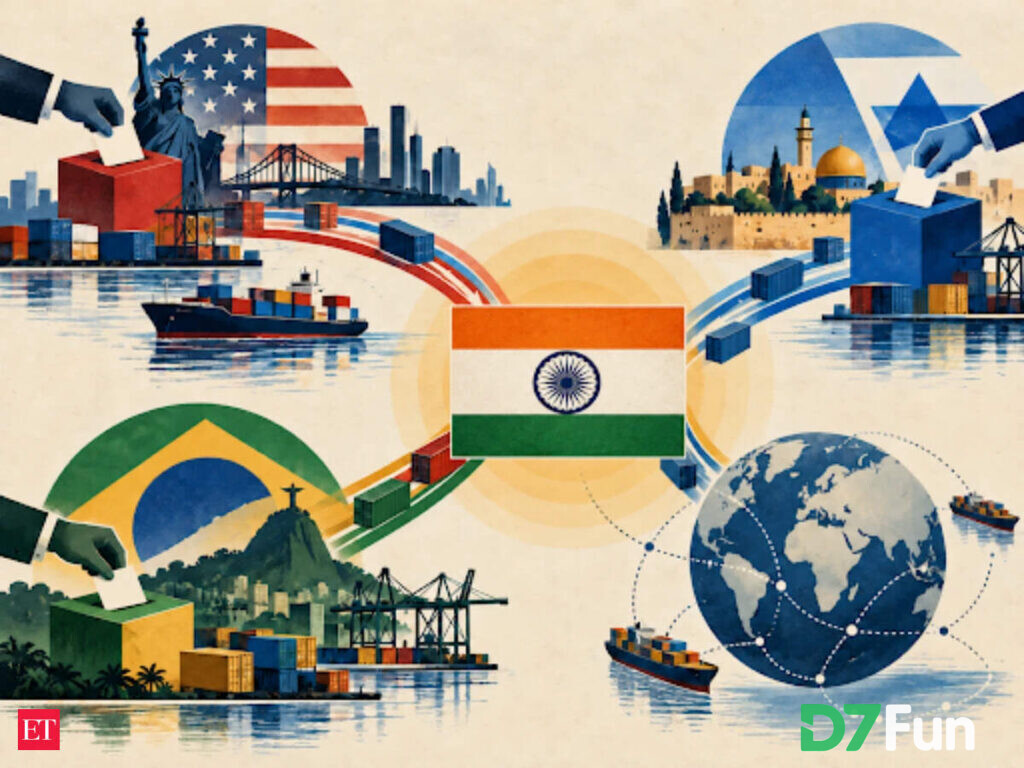
Global Elections, Local Impact for India
India’s trade and economic partnerships are closely linked to developments in major global markets, and recent elections in the United States, Brazil and Israel are expected to play an important role in shaping those ties. For Indian exporters, policymakers and industry groups, the outcome of these political shifts could influence everything from market access to sector-specific cooperation.
With India looking to expand its export base and strengthen strategic economic relationships, these three countries remain important partners. Each market brings a different opportunity for Indian businesses, whether in goods, services, technology, agriculture or defence-linked sectors.
US Trade Talks Could Move Closer to Completion
The United States continues to be one of India’s most significant trade partners, and discussions around a broader trade pact are being watched closely by businesses on both sides. A possible agreement could open new pathways for Indian exports, especially in sectors that depend heavily on access to the American market.
Indian companies have long viewed the US as a major destination for pharmaceuticals, engineering goods, IT services and specialty products. Any progress in trade negotiations may help improve business confidence, reduce friction in certain areas and create a more stable environment for long-term planning.
For India, the stakes are high because even small policy changes in the US can have a broad effect on exporters. A stronger trade framework could support more predictable market access and deepen cooperation in areas that matter to both economies.
Brazil and India Eye Bigger Economic Ambitions
Brazil is another country where election outcomes could matter for India’s trade strategy. The two nations have been steadily building a stronger economic relationship, and both sides have expressed interest in moving toward more ambitious trade goals.
Brazil offers India opportunities in areas such as agriculture, energy, minerals and industrial products, while Indian businesses see room for greater engagement in chemicals, pharmaceuticals and technology. As both economies continue to diversify their global ties, there is growing interest in expanding bilateral trade beyond traditional categories.
For Indian traders and investors, Brazil’s political direction may influence the speed and scope of future engagement. If the momentum continues, the relationship could become a more important part of India’s outreach to Latin America.
Israel Remains Key for Defence and Trade Cooperation
Israel’s elections have also drawn attention in India because of the close strategic relationship between the two countries. Defence collaboration has long been a major pillar of the partnership, and continuity in this area remains important for India’s interests.
At the same time, negotiations for a free trade agreement between India and Israel are seen as an important step in broadening the economic relationship. Such an agreement could help Indian firms explore new opportunities in technology, agriculture, infrastructure and advanced industrial products.
Israel’s role in innovation and high-value technology makes it a valuable partner for India, especially as Indian industries seek advanced solutions and stronger international cooperation. A steady political environment there could support both ongoing defence ties and future trade expansion.
Why These Markets Matter for India
The combined importance of the US, Brazil and Israel shows how global politics can directly influence India’s trade agenda. For a country aiming to boost exports, attract investment and strengthen strategic partnerships, election results in these nations can carry serious economic meaning.
As India continues to position itself as a major participant in global supply chains, developments in these key markets will likely remain under close watch. The coming months may offer clearer signals on whether trade talks move forward, whether targets become more ambitious and how India’s commercial links with these countries evolve.
For Indian businesses, the message is simple: the next phase of international trade may depend not only on economics, but also on political choices made far beyond India’s borders.


